Surf, whales, and the country's biggest city
Ecuador's Pacific coast is the country's least-visited region and, for many travelers, its most surprising. Fishing villages where the day's catch lands on the beach at dawn. A surf town that never sleeps. A bay where humpback whales calve every southern winter. And Guayaquil — chaotic, humid, enormous — with the best waterfront promenade in the country.
The coast pairs naturally with the highlands: highland mornings, ocean sunsets, a 6-hour bus ride apart.
Where in Ecuador
Illustrated treasure map Otavalo
Quito
Latacunga
Baños
Riobamba
Cuenca
Manta
Puerto López
Montañita
Salinas
Guayaquil
Lago Agrio
Coca
Tena
Galápagos
Otavalo
Quito
Latacunga
Baños
Riobamba
Cuenca
Manta
Puerto López
Montañita
Salinas
Guayaquil
Lago Agrio
Coca
Tena
Galápagos
Illustrated treasure map. Not for navigation. Open in Google Maps ↗
Montañita: the surf town
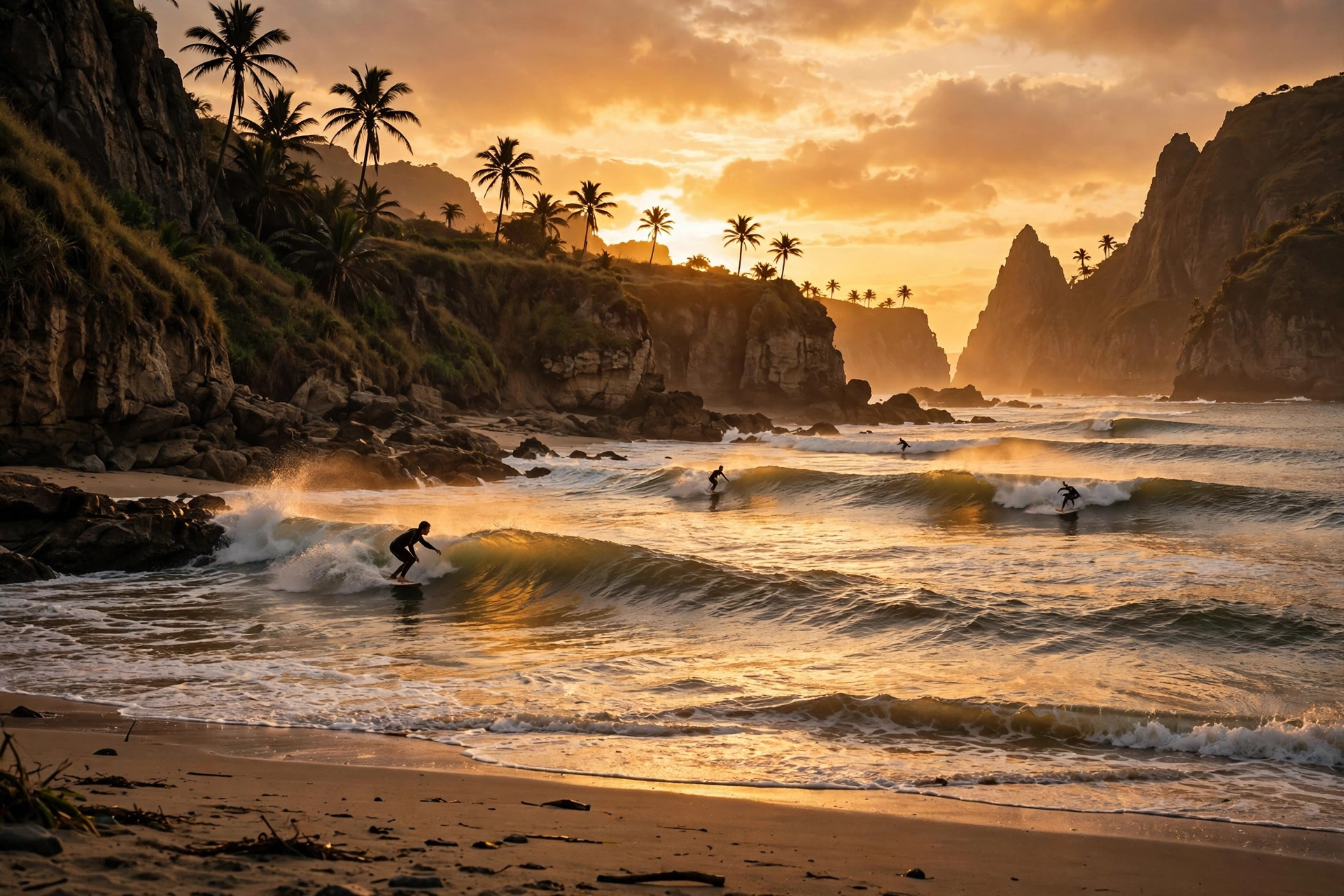
Montañita is Ecuador's famous beach town — surf by day, bonfires and dancing by night, in a way that has barely changed in thirty years. The point break works year-round; beginners take lessons on the beach break. It is backpacker-central: hostels, smoothie bowls, reggae, and a main street that stays up late. Love it or leave it after a night — but surfers should give it three days. Nearby Olón is the quieter sibling: same ocean, calmer scene, better for families. Read the full Montañita deep dive — surf, food, stays, and day trips.
Puerto López and Machalilla: whale country
Puerto López is a working fishing town inside Machalilla National Park, and from June to September it becomes Ecuador's whale-watching capital: humpback whales migrate here to breed and calve, and the tour boats go out daily. Verified Oct 2026 The same boats run to Isla de la Plata — "the poor man's Galápagos" — where blue-footed boobies, frigatebirds, and sea lions hold court an hour offshore. On land, the park protects Los Frailes, routinely called Ecuador's most beautiful beach: a crescent of white sand with a cliff-top trail, no development, no vendors.
Guayaquil
Ecuador's largest city (nearly 3 million in the metro) and its economic engine. Guayaquil has a rough reputation and a revitalized center worth a day or two:
- Malecón 2000 — 2.5 km of riverfront promenade along the Guayas: gardens, monuments, the MAAC museum, and the best people-watching in the country.
- Las Peñas — the city's oldest neighborhood, 444 steps up Cerro Santa Ana past colorful colonial houses to a lighthouse with panoramic views.
- Parque Seminario — "Iguana Park," where dozens of land iguanas roam free among the office workers.
- Mercado Artesanal and the food scene — Guayaquil takes its encebollado seriously, and you should too.
Guayaquil is also the practical gateway: the international airport (GYE) often has better connections than Quito, and it is the jumping-off point for Galápagos flights.
Manta and the Manabí coast
Manta is the tuna port and the coast's most developed city — a long malecón, a real food scene, and the jumping-off point for the dive sites around Isla de la Plata. South of Manta, the Manabí coast strings together fishing villages (Puerto Cayo, Machalilla), the Panama-hat weaving town of Montecristi (the genuine article — "Panama" hats have always been Ecuadorian), and the archaeological site at Agua Blanca, where you can walk a pre-Columbian Manteña settlement and then soak in a sulfur lagoon.
Salinas and the Santa Elena peninsula
Salinas, two hours west of Guayaquil, is where Ecuadorians go to the beach: high-rises, a yacht club, and the sea-lion colony at La Chocolatera (the westernmost point of Ecuador's mainland). Whale watching runs here in season too, and the nearby Ballenita and Ayangue coves are quieter alternatives.
Tours we're vetting for The Pacific Coast
We're lining up launch partners for guided tours in this region — operators we'd book ourselves. When we recommend one, we'll tell you exactly why, and any commission will be disclosed here.
No paid placements yet — when affiliate links go live here, they will be disclosed.
The food of the coast
Coastal Ecuadorian food is a reason to come by itself:
- Encebollado — tuna soup with yuca, red onion, and lime. The national hangover cure and, to many Ecuadorians, the national dish. Eat it for breakfast like a local.
- Ceviche ecuatoriano — shrimp ceviche served with popcorn and plantain chips (chifles), distinct from the Peruvian style.
- Encocado — fish or shrimp in coconut sauce, the taste of the northern coast (Esmeraldas).
- Corviche, tigrillo, bolón — the green-plantain trinity. Order all three; thank us later.
Where to stay in The Pacific Coast
Our vetted stay partners for this region are coming with the launch. Until then, every hotel and lodge mention in this guide is editorial — nobody paid to be here.
No paid placements yet — when affiliate links go live here, they will be disclosed.
A note on safety
Santa Elena and Manabí provinces currently carry a U.S. State Department Level 3 "Reconsider Travel" designation (crime and terrorism) — province-wide, not a do-not-travel order. Verified Oct 2026 The tourist towns above (Montañita, Puerto López, Salinas) operate normally and see steady visitor traffic, but check the live advisory before you book, travel the main routes in daylight, use registered taxis at night, and ask your hotel about local conditions on arrival. See Essentials for the full picture. check before you go